A Complete Guide to ACM Panels for Modern Building Exteriors
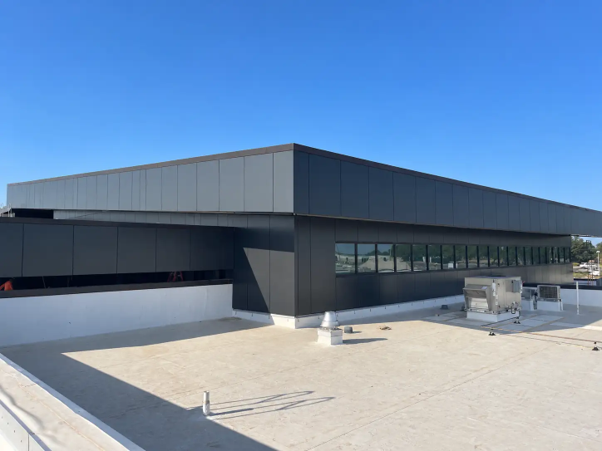
Quick answer: Aluminum composite panels are lightweight architectural cladding made from two aluminum sheets bonded to a core. They’re commonly used on commercial building exteriors because they can be cut and folded into custom facade designs and come in a wide choice of colors and finishes. Some ACM cores are combustible, so you need to specify a core that meets your building’s fire-safety requirements. The wall and attachment system must also be able to support the panels and withstand wind loads. Clark Roofing can fabricate and install ACM panels for your commercial facade.
___
Contemporary commercial exteriors rely on ACM for lightweight, perfectly flat cladding with sharp joint lines. It offers an instant visual upgrade for older properties without the demolition and/or structural reinforcement required in masonry.
What are aluminum composite material panels?
ACM, or aluminum composite material, is a panel made from two thin aluminum skins bonded to a core. This layered construction makes the panel rigid but relatively light. It can be cut and formed into precise sizes before installation. Before specifying ACM, you need to confirm that the core and wall system meet the fire requirements that apply to your building.
Note that ACP (aluminum composite panel, ACM (aluminum composite material, and aluminum siding panels are all different names for the same engineered cladding panels designed specifically for commercial building facades. Unlike off-the-shelf siding, these panels are custom-planned and installed with dedicated attachment systems.
Why are ACM panels used in modern construction?
ACM solves several problems because:
- Aluminum composite panels place much less weight on the building compared with brick or natural stone. This makes them suitable even for older buildings. Lighter panels also tend to be easier to handle during installation.
- Aluminum siding panels can take custom colors and finishes that align with your brand. Fabricators can fold the metal around edges to create crisp corners that painted walls can’t match.
- ACM can resist ordinary exposure to sun and moisture.
- ACM exterior cladding doesn’t need to be repainted as frequently as a conventional painted exterior. They can last decades if installed correctly and cleaned regularly.
Common Applications of ACM Panels in Commercial Buildings
Aluminum composite panels can be used as the main façade material, but they are also often used alongside glass and masonry. Panel colors and finishes can be coordinated with metal roofing.
- Office buildings and corporate facades – You can use ACM for frame glazing or to cover large wall areas with a uniform finish. The material works especially well if your goal is to create a high-end sheen that both conveys a modern corporate image and requires minimal ongoing maintenance.
- Retail stores and shopping centers – Retail properties often use ACM to add definition around entrances and storefront bands. The material is widely used for maintaining a consistent visual identity across multiple locations or tenants.
- Schools, healthcare, municipal buildings – Public-facing buildings need durable exterior materials, and that’s exactly what ACM is. Aluminum composite panels can be specified to suit the building’s code requirements.
- Canopies, soffits, and exterior features – Panels can also finish the underside of a canopy and conceal structural elements. They can add visual contrast around an entrance, too.
- Exterior renovation projects – ACM exterior cladding can be used to quickly update the façade of older commercial properties without needing to demolish existing framing (which often needs to be done when retrofitting with traditional materials like brick or stone).
Understanding ACM panel cores and fire safety
The material used for the core of aluminum composite panels has a major effect on how the panel reacts in a fire.
Polyethylene (PE) core
PE-core panels are less expensive. However, they’re not suitable for all exterior wall applications. They may be appropriate for some low-rise facades, provided that the full wall assembly has the required approval.
Fire-retardant (FR) core
FR-core ACM panels use a core with a high proportion of mineral filler, which is intended to make them less likely to fuel a fire (compared with a standard PE core). They’re often the best choice for commercial facades and projects where the specified wall assembly calls for a higher-performing core. Note that being fire-retardant doesn’t make a panel automatically compliant. The specified system still needs to meet the project’s requirements.
Non-combustible core options
Some manufacturers produce high-mineral core panels for commercial buildings that are subject to stricter standards, such as hospitals or high-rise projects. Always check the manufacturer’s documentation.
ACM panels vs. traditional exterior materials
| ACM panels | Brick | Natural stone | Stucco | Solid metal panels | |
| Relative weight | Low | High | High | Lower than masonry | Varies by material and thickness |
| Typical appearance | Smooth panels; consistent color and finish | Textured, traditional | Natural variation and texture | Continuous, textured surface | Smooth, contemporary finish |
| Installation complexity | Requires a subframe and precise panel layout | Labor-intensive masonry work | Heavy; may need specialized anchoring | Applied on site | Precise fabrication and attachment needed |
| Maintenance | Routine cleaning; inspect joints and sealants | Mortar may need repair | Individual pieces may need repair | Cracks may need repair; may need repainting | Monitor the finish and fasteners |
| Design flexibility | High | Low | Limited by available stone and cuts | Moderate | High |
What should you consider before choosing ACM panels?
- Building height and use: Does the core and wall assembly meet the fire requirements for your building?
- Appearance: Have you settled on the finish and panel layout?
- Project timing: Is your façade design ready for fabrication? (Your installer needs accurate final measurements before panels are made).
- Future upkeep: How will you clean the panels or replace one if it is damaged?
Conclusion: Making an informed ACM panel choice
Aluminum composite panels can give your commercial building a makeover at a fraction of the structural load of traditional masonry or stone. To get the most out of your investment, prioritize safety and performance from the start. Choose the right core composition based on building height and occupancy, and make sure to fully test the wall assembly to meet all local building code requirements.
Talk to our team here at Clark Roofing to discuss your ACM panel fabrication and installation project.
Frequently asked questions
Is ACM the same as ACP?
Yes. People often use the terms interchangeably. ACM means aluminum composite material, while ACP means aluminum composite panel.
Can ACM be used on renovation projects?
Yes. In fact, its relatively low weight makes it suitable for updating an older façade. Of course, the existing wall should be strong enough to support the specified attachment system.
How do I choose the right ACM core?
Match the core to your building’s height and safety classification. Note that taller structures and high-occupancy public spaces legally require fire-retardant or non-combustible mineral cores to pass assembly testing.
Do ACM panels need much maintenance?
This depends on the finish and exposure conditions. They usually only need routine cleaning to stay looking their best. Perimeter components such as joints and sealants also need to be routinely inspected.
Can ACM panels be used with other exterior materials?
Yes. You don’t have to cover the entire building in aluminum siding panels. They actually look great when paired with large glass facades or used to accent traditional brickwork.