
PVC vs. TPO – Which Roofing Material Is Right for Your Property?
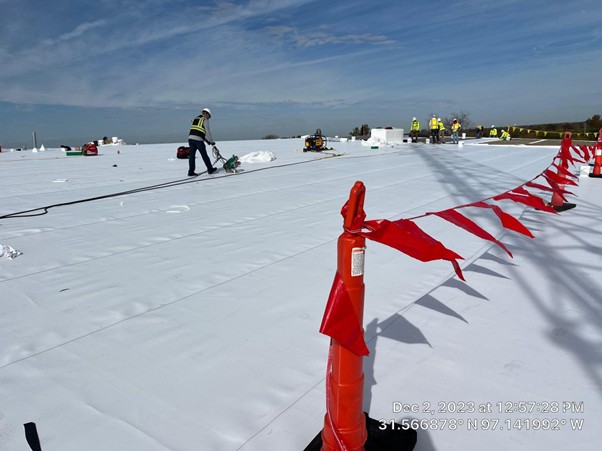
When it’s time to choose a roofing system, you’ll likely need to compare TPO vs. PVC roofing. Both materials are widely used on commercial buildings and can also work well for residential properties with flat or low-slope roof sections. But while they share some characteristics, they differ in how much they cost and how they hold up over time, so it’s worth understanding what sets them apart before you decide.
By understanding how TPO vs PVC compare, you can decide which roofing material fits your commercial building construction.
Product overviews
PVC roofing membrane
Roofers in Waco, TX, have been installing PVC (polyvinyl chloride) as a single-ply thermoplastic roofing membrane for commercial buildings since the 1960s. A typical PVC membrane consists of two layers of PVC material with a polyester reinforcement, known as a scrim, sandwiched in between. This construction makes PVC inherently strong and flexible.
PVC is known for its chemical and oil resistance, and it also possesses strong fire-resistant performance. Because of these qualities, flat roof PVC is commonly used for restaurants and factories, as well as other facilities where exposure to harsh substances is more likely.
TPO roofing membrane
The TPO commercial roof is the newer single-ply roofing option that gained popularity in the 1990s. TPO (thermoplastic polyolefin) is made from a blend of polypropylene and ethylene-propylene rubber, so it will give you the strength of rubber roofing and the heat-welded seams similar to PVC.
Unlike PVC, TPO costs much less upfront. You might also appreciate its bright reflective surface, which could help reduce heat absorption and improve energy efficiency in your commercial building.
Advantages and Disadvantages
When comparing TPO vs PVC roofing, understanding their pros and cons can help you decide which material suits your commercial property.
PVC roofing benefits
- Strong resistance to chemicals and grease.
- Excellent fire resistance with self-extinguishing properties.
- Proven performance history spanning more than five decades.
- Maintains flexibility across a wide range of temperatures.
PVC roofing limitations
- Higher initial investment, that’s usually 10% to 20% more than TPO.
- Environmental concerns due to the chlorine content.
- Plasticizers can migrate over time, causing the membrane to stiffen.
TPO roofing benefits
- Lower upfront installation costs compared to PVC.
- More environmentally conscious since it contains no chlorine.
- A highly reflective ‘cool roof’ surface that can give you energy savings.
- Strong puncture resistance, especially when newly installed.
TPO roofing limitations
- Its performance history spans only around 30 years.
- Quality and durability can vary depending on the manufacturer’s formulations.
- May deteriorate faster when installed in areas with intense heat or prolonged UV exposure.
Hail impact ratings
When choosing a roof for your business in Texas, you’ll want to make sure that it can withstand hailstorms to minimize damage and repair costs. The good news is that both PVC and TPO roofing systems are designed to handle harsh weather conditions, including hail events that can damage many other roofing materials.
Knowing their impact ratings can help you understand how TPO and PVC can protect your property from hail impact damage.
UL 2218 Class 4
PVC and TPO membranes commonly achieve the highest impact resistance rating, Class 4. This rating means the material can withstand the impact of a 2-inch steel ball dropped from a height of 20 feet without cracking or splitting.
FM 4470 severe hail ratings
Many premium PVC and TPO commercial roof systems also meet FM Global’s severe hail (SH) or very severe hail (VSH) standards. These ratings indicate that your roof can hold up under intense hail and wind conditions often found in storm-prone regions like Texas.
Performance comparison
When newly installed, TPO is often described as more rubber-like. That’s not a bad thing, as it can help absorb impact energy effectively. However, keep in mind that a flat roof made with PVC tends to retain stronger seam performance over time. Meanwhile, older TPO membranes may become more difficult to repair after hail impact due to surface oxidation.
Market Usage: United States vs. Texas
| Roofing Type | Entire US (%) | Texas only (%) |
| TPO | 38 | 45 |
| PVC | 34 | 35 |
| Others | 28 | 20 |
TPO currently leads in the commercial roofing market due to its balance of performance and upfront affordability. When you look at figures across the United States, TPO accounts for about 38% of the single-ply roofing market, while PVC follows closely at roughly 34%. The remaining share includes other systems such as EPDM and modified bitumen.
In Texas, TPO’s presence is even stronger, and it’s easy to see why. When you’re in the Southwest, you’ll need a reflective roofing system that can help manage interior temperatures against extreme heat and high levels of solar exposure. With competitive pricing and strong initial reflectivity, TPO can also be a great choice for expansive warehouses and distribution hubs, as well as retail buildings throughout Austin, Houston, and Dallas.
What’s best for your commercial property?
Both TPO and PVC roofing perform well on commercial buildings in Texas, but the right choice depends on your property type and budget.
When it comes to commercial projects, we often recommend TPO here at Clark Roofing. That’s because we have seen how effective it is in handling the hot, sunny conditions in Texas. Plus, you won’t have to worry about replacing your roof for a very long time, thanks to its 15 to 30-year service life. If you’re building an office or warehouse, or even a retail space, do consider installing a TPO roof for extra peace of mind.
As for PVC roofing, it’s best suited when your building is in a harsher environment, such as hurricane-prone zones and high-wind areas. With PVC, you don’t have to worry too much about flying debris damaging your roof.
Still unsure which roofing suits your building? Clark Roofing, a roofing company in Waco, can give you more insights based on your situation and needs.
Consult our experts!
With Clark Roofing, you’ll get reliable commercial roofing services throughout Waco and Dallas. Our team can review your building needs and recommend the most practical solution if you’re deciding between TPO and PVC. Give us a call at 254-374-4477 so we can discuss your commercial roofing project and schedule a consultation.